Research Project
Precision Targeting of Pathological Senescence via Innate Immune Redirection using a Novel Recombinant uPAR Ligand
- Principal Investigator
- Patwardhan, Manali Nitin
- Research Area(s)
- Ongoing Projects
Abstract
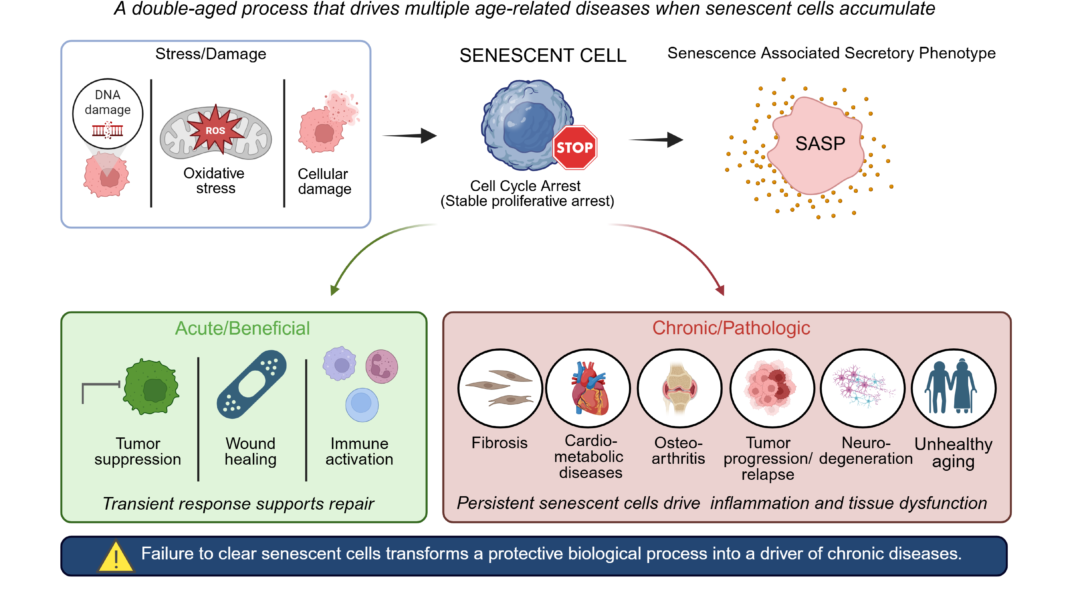
Cellular senescence is a double-edged process: while acutely protective in tumor suppression and would healing, accumulation of senescent cells drives chronic inflammation, fibrosis, and tissue dysfunction through senescence-associated secretory phenotype (SASP). Despite this, there are currently no FDA-approved precision senolytics. Current small-molecule approaches lack specificity and cause systemic toxicity, while CAR-T strategies face safety, persistence, and cost barriers. Wellness behaviors including diet, mindfulness, and exercise – though associated with improved healthspan, have poor uptake and penetration societally. The identification of urokinase-like plasminogen activator receptor (uPAR) as a conserved marker of pathological senescence created an opportunity for targeted elimination. We aim to develop a rapidly deployable, non-genetic immunotherapeutic platform to selectively eliminate senescent cells, potentially restoring tissue function and extending health span. Our laboratory has developed a novel recombinant protein derived from the natural high-affinity ligand of uPAR. Our innovation defines a new class of "Precision Senolytics" by exploiting a specific biological vulnerability, the uPAR-uPA axis, rather than relying on small molecules with promiscuous activity against multiple intracellular targets. Our recombinant protein functions as universal targeting arm: the same core sequence can be repurposed to create novel bispecifics, Fc fusion proteins, or effector cell engagers. Because of the simplicity of our biologic-based strategies to restore tissue homeostasis, there is an opportunity to equitably advance precision senolytics.